After about 15 years, I’m retiring Collision Detection. (I’ve posted so infrequently in the last three years that it’s been essentially retired anyway, heh.)
But hey! I’ve started a new site over at my namesake URL, www.clivethompson.net. I’ll be posting occasional essays and building an archive of all my journalism over there.
Go over and check it out! Because there’s so much fun stuff I’ve done on Collision Detection, though, I’m not taking this site down. I’ll leave it here until the server crashes or the sun burns out, whichever comes first.

I recently picked up 1001 Video Games You Must Play Before You Die. I couldn’t resist the title, which so neatly refracts the gibbering cultural anxieties of lists like “1000 novels everyone must read”. You see this sort of highbrow listicle often in the realms of literary fiction, movies, possibly poetry. It’s classic canon panic, and I say that with a degree of charity and warmth; I actually think arguing heatedly and even snobbishly about what works of art are important and mindbending can be a lot of fun, and occasionally useful to the parties involved.
But there’s something hilarious and unsettling about claiming there are 1,001 video games we must play. On the obvious level, it’s a cheeky way of mocking the way literary fiction — or perhaps movies — are the only arts that self-aggrandizingly proclaim themselves highbrow enough to be considered absolutely compulsory for all non-knuckle-dragging hominids. On a subtler level, it throws a challenge even to gamers themselves. It suggests that no matter how many titles they’ve played and enjoyed (or hated), there is a much, much larger sea out there. Indeed, the idea that there is a subset of games that are mandatory, and that this number is as large as 1,001, points to the fact that the pool of nonmandatory games (the bad ones, the forgettable ones, the aesthetically and game-mechanically uninspired ones) is probably several orders of magnitude bigger — tens of thousands, maybe hundreds of thousands of games. Maybe more?
I mean, how many video games have been made, anyway? I’ve never seen a good estimate of this. When you throw in disposable app-store games — the phyloplankton of the game world, some so forgettable you’d swear they’d just been procedurally generated (and come to think of that, that would make a crazy project! A robotic game studio that craps out algorithmically-generated games, much like the programmers who bulk-spray thousands of algorithmically-generated books onto Amazon) — the number becomes Carl-Sagan huge.
Could anyone actually play 1,001 games? Let’s do the math! Since modern games promise, in general, “40 hours of play”, we’re talking about 40,000 hours of play. Actually, let’s shrink that down to 30,000 hours, because many early arcade games discussed in this book could be “played through” in a few minutes or an hour or so. But even at 30,000 hours, that’s 14 solid years of playing, if you took it on as a full-time job, played for 40 hours a week, and tried to get to the end of every game.
The upshot is, the whole sly point of a book like 1001 Video Games You Must Play Before You Die is that you’re really never going to be able to play them all. The fun is in reading about them — in touring through the encyclopedic entries.
In this regard, I gotta say, the book does not disappoint. The writeups are all barely a villanelle’s-worth in length — a single short page, or even half a page — yet the writers (about two dozen game journalists) manage to fit in a number of really delightful observations.
Which brings me to the whole reason I’m writing this post! In the writeup for Half-Life 2, Duncan Harris makes a fascinating argument about the title. I’ll quote nearly the whole writeup:
Released in 2004 after five years in development, it continues the story of an alpha geek, scientist Gordon Freeman, as he deals with the aftermath of an experiment gone wrong. Placed back on Earth by the mysterious G-Man, he finds himself entering City 17, the cold and forbidding capital of the world now enslaved by aliens. The Combine, who snuck into our dimension, thanks to the events of Half-Life, have broken humanity’s spirit and turned it cities into ghettos. Citizens wear rags and huddle next to tenement windows, waiting for the Civil Protection squads to abduct them to who-knows-where. There are no children.
Had the game been so vulgar as to mimic any movies, there’d have been a Hollywood version years ago. But the secret of it success is that, while full of historical parallels, it tells its story as if games were the only medium on Earth. There are no cut scenes, no paragraphs of exposition to read, and the closest you’ll get to pop-culture references are Orwell and H.G. Wells. In their place, Valve’s artists, technicians, storytellers, and sound engineers create a unique milieu: a distinctly Soviet metropolis being literally consumed by alien architecture.
It tells its story as if games were the only medium on Earth. That is a really great observation, even if it’s not true, and I’m not sure it is. (Among other things, the story, characters and dialogue are pretty straightforwardly modeled on the tropes of action flicks.) But the gist of the point — that what makes a game interesting is its desire to be gamelike, to take its reference points from other games, to regard gameness as central — is nicely put.
This is one of the reasons I’ve always dug third-person video games. Their camera aesthetics are totally weird and utterly game-like. When you play, you’re almost always constantly staring at the back of your character, as you guide it around the world, as per last year’s Tomb Raider, an early pioneer in the third-person perspective back in the 90s:

This is a camera technique born of pure functionality: As a player, you need to be seeing the world in front of your character, so the camera-view must always be floating just behind the character, as if you were a spirit anxiously accompanying your creation. And of course when your character is in tight quarters, like a hallway, the “floating behind” camera view gets all screwed up, with the camera often getting stuck behind objects or appearing to float inside walls.
The thing is, the third-person game camera-angle is truly and totally foreign to Hollywood. I can’t imagine any director saying “guys, guys! I’ve got a great idea! Let’s shoot our entire movie from about five feet behind behind the protagonist, carefully tracking behind her, so that we almost never see her face!” That third-person angle is a piece of artistry that is utterly gamelike — a bit of aesthetics crafted as if games were, indeed, the only medium on Earth.

That’s one of the opening pages of Conjectures on Original Composition, a book about creative genius published by the English poet Edward Young in 1759. It’s considered one of the first big essays to tout the idea that “originals” — writers of deep originality — are more important and awesome than derivative folks. I heard about Conjectures while reading a different essay this evening, and since I’m sort of obsessed with tracking the rise of our modern (and disastrous) conceit that originality is something that just kind of wells up from inside you I immediately dialed up Conjectures on Google Books to read it. It’s a delightful essay, but what struck me immediately was its design: Those tiny pages, crammed full of large-fonted prose.
It looks just like a book displayed on a smartphone screen.
That small-page format was quite common back in the 18th century. It’s known as octavo duodecimo — with pages that are about 6 inches by 9 inches. The entire Conjectures is only about 8,000 words long, but it was common to print essays in this pretty little style, because it had great ergonomics: It made for easy one-handed reading and portability.
Pretty much the same advantages as reading on a smartphone, when you think about it. When it comes to books, I read about half my stuff these days in print, and half in e-format; and while I own a Kindle, I don’t use it very much any more — I just read ebooks on my Android phone. Indeed, reading on my phone has led me to read more books than ever, because the octavo-esque portability means the books are ever with me: I dip in and out while riding the subway, waiting in line at a store, lying in bed falling asleep, or lying in bed awake with “early waking insomnia”, yay. The portability has made it possible for me to read books sufficiently huge that, had I’d been forced to carry ‘em around, I’d probably have ditched out and never finished them — things like War and Peace, Middlemarch, and Moby Dick, all of which I read entirely on my smartphone.
In fact, one of the oddly useful things about reading War and Peace on your phone is that the octavo-like format makes the epic enormity of the tome less intimidating: It’s just one little page after another, each one oddly inviting. I tend to blow up the font on my phone to quite large, so each page has only a few hundred words on it, precisely the way that Conjectures is laid out. Here’s a page of Conjectures …

And here’s a page of a book I’m currently reading on my smartphone (sorry for the crappy resolution of the font, which looks weird when I size it comparably):

The point being, of course, that the ergonomics of smartphones as reading devices are not only kind of rad, but historically so.
These small formats from days of yore also help explain the stupendous productivity of many historic authors. I’ll often be reading about a nonfiction essayist from the 17th or 18th or 19th century and the bio will mention he or she wrote 56 books or some other ungodly number, and I’ll freak out: Man alive! How can anyone generate so much?
But then you realize that a “book” back then wasn’t what we think of as a “book” now. Back then, there were a plurality of book-sized formats that were, like octavo or the slightly-smaller duodecimo, pretty compact, so these “books” were only a couple of thousand words long. (Like the totally fun The Art of Memory by Marius D’assigny, from 1706.) Authors who cranked out 40 “books” were actually writing pieces that are closer to a long magazine article.
It wasn’t until the 20th century arrived that nonfiction books started to congeal into the 300-page quantum, for a host of economic and cultural and industrial reasons. To wit: If you’re going to charge someone $25 for a hardcover nonfiction book and do it via industrial publishing, you have to make the customers feel they’re getting $25 worth, which means the book has to be loooooong … even if the author does not possess an argument requiring 300 pages. (Thus we find so many books that are really just magazine articles gasified to fill the container.) The emergence of digital formats for books is changing these industrial economics, with some pretty cool aesthetic and intellectual effects. If you don’t need to charge $25 for a book, you don’t need it to necessarily balloon to 300 pages, so you can begin to publish books that look more like … Conjectures or The Art of Memory. The book fits the length of the utterance, instead of expanding to fill a vessel the dimensions of which were determined by haptic marketing: “Yeah, this book feels weighty. I’m in!”
Part of what made me think about these cool, short, old book formats is that the recent discussion/debate about “long form” writing. I’m thinking particularly of Ben Smith’s terrific meditation on how they’re integrating longer pieces into Buzzfeed. As he notes, when you don’t have an artificial constraint, form fits function: “This is more like book-writing, less like the compromises of magazines and newspapers …”
The only thing I want now is for someone to sample those amazing fonts they used for Conjectures and The Art of Memory, and instal them on my phone. Holy moses, the fonts that come with the Kindle app on Android are flavorless. Look at the gorgeous fontistry of those old books! Just look at it!
UPDATE: In this post I originally misidentified the size of the book as duodecimo size, 5 inches by 7 3/8 inches; then John Overholt, a curator of early modern books at Harvard, pulled a copy of Conjectures out of his stacks to verify the dimensions: Check out John’s excellent comment below, which I’ve excerpted. Thanks John!
The Essay is actually a small octavo, the next size up from duodecimo, which I have the sense would have been a little beneath the dignity of such a piece. I did see that there was also a pirated Dublin edition in 12mo in just 60 pages, which would have been set in a much smaller type, to keep the book considerably cheaper than the 1£ 6s of the London original.
Bonus: John snapped this shot of himself holding the book:


(This year, I’m participating in The Pastry Box Project, a very cool joint blog; I’ll be doing six posts this year. My first went up this week, and here’s a copy of it!)
Two years ago I was trying to think of something to get for my wife for her birthday, and I was stuck. So I decided to go the “heartfelt” route and make her something by hand: The personal touch! But what would I make?
Well, I’m a big nerd from way back, and she’s also something of a nerd too. So I decided that I’d make her something peculiarly digital: A personalized video game.
I downloaded a copy of Inform 7, a free and easy-to-use app that lets anyone create “text adventure” games, where the player navigates a world of text by typing commands and reading descriptions of the rooms they enter (“Go west”; “open mailbox”). My wife and I are both in our 40s, so we’re old enough to remember the first-ever text-adventure games like “Zork”. I still enjoy the stark poetry of “Zork”’s opening scene:
West of House
You are standing in an open field west of a white house, with a boarded front door. There is a small mailbox here.
That scene always reminds me of the first few lines of Dante’s “Inferno”:
Midway along the journey of our life
I woke to find myself in a dark wood,
for I had wandered off from the straight path.
I’m probably picking up these resonances because I’m middle-aged, so my grade-6 days playing “Zork” seem awfully far away now, while the cosmic midlife freakouts of the “Inferno” are a lot more proximal. But at any rate, I liked the idea of creating a little playable literary world to give to my wife, a sort of geeky love letter. I began plotting out a text adventure that was based in our years together, with a few dozens rooms and filled with detail and easter eggs (hidden stuff you have to discover inside a game) drawn from our shared experiences. It was fun and not terribly hard to do; I’d never created a text adventure before, but Inform 7 is reasonably straightforward. After several evenings of work, I had the game done, and on her birthday I loaded it onto her computer and explained what I’d done. I was half worried she’d think I was nuts, but to my great delight she loved it.
Here’s how the game opened up:
Bedroom
You wake up in your bed at home. The sun is coming in the windows, and you feel deeply rested. What time is it?You roll over and grab your iphone, and holy moses — it’s 9:30 am on a Saturday! You hear a beep and look over at your sidetable, where you see an ipad.
Now, here’s the thing: That’s all you get to see.
I’m not going to show you any more.
And that’s because a game like this doesn’t quite behave the way games normally do.
Normally, games are a form of mass entertainment. They’re a one-to-many medium. A single entity — sometimes a big corporation, sometimes an indie creator working alone — creates what is (hopefully) a fiendishly fun system, and gamers try to master it, playing and replaying it again, slowly getting better and better, as with Call of Duty or Candy Crush. With games like this, the designers want as many people as possible to play their titles, of course. The more people they get hooked, the more money they make.
In recent years we’ve seen the rise of something different: Artistic games, where the designers are aiming to create an expressive act. They’re trying to evoke an emotion or a mood, or to make a point. (A superb example of this sort of art game is Jason Rohrer’s “Passage”.) These games aren’t designed to get you addicted, seducing you into playing them over and over again. If you run through “Passage” two or three times, you’ll understand the message and experience Rohrer is trying to communicate, and you probably won’t need to play it any more. Artistic games turn the genre into something that’s more obviously a speech act — games and their rulesets as a way of talking about the world. (The scholar and game designer Ian Bogost calls this “procedural rhetoric”.) Nonetheless, these art games share one thing in common with Call of Duty or Candy Crush: They’re still a one-to-many medium. The game designer creates the experience, hoping that many people will play it, much as a poet writes a poem hoping that many people will read it. The game is made for an audience of many.
The game I made for my wife is something rather different. It was a game made for an audience of one.
The reason I’m not showing you the whole game is for the same reasons we don’t show our love letters to the public. They’re private communications, composed with a single person in mind. Indeed, even if I did put my game online for everyone to play, it wouldn’t make any sense. None of the objects inside the rooms have any meaning to anyone but my wife and I. They’re a rumination on our shared experiences, so if you didn’t experience them, they won’t make much sense. My wife enjoyed the game (thank god) and found it meaningful; you’d find it boring gibberish.
All of which makes me realize that the evolution of games as a medium might be entering a very cool and strange phase.
Every year there are more tools for authoring games, ranging from things like Inform 7 to Scratch or Stencyl. They’re still kludgy, but getting simpler all the time. They remind me of early-stage word-processors in the 70s or 80s. Those tools deindustrialized typography, making it possible for an individual to dash off a document that had a level of formatting previously only available to those who owned a printed press. As games become easier and quicker to make, they enter similarly new expressive territory. A tool like Inform 7 deindustrializes the making of games. And when a medium is deindustrialized, it always get wilder and weirder. Once millions of people can mess around with it, they inevitably do things that are far more diverse and crazy and unexpected than when the medium was in the hands of only a few huge corporations.
We can now start thinking about dashing off a game as a way to joke with a close friend, to invite someone to a party, or maybe to apologize to someone you’ve treated poorly. Games become something you can create for an audience of one.
If you made a game for one person, what would it be like?
Yesterday I saw a picture on Boing Boing: A “behind the scenes” shot of how they made the iconic opening “crawl” text for The Empire Strikes Back. I’d always assumed, naively, that the crawl was done with computer graphics, but no: It was a steampunk affair, with the text printed on a piece of glass and filmed at a steep angle by a camera. But what really struck me was the quote from George Lucas about the formal properties of a crawl:
“The crawl is such a hard thing because you have to be careful that you’re not using too many words that people don’t understand,” Lucas has said. “It’s like a poem.”
Poetry! Full on! This immediately made me think of an idea, which I tweeted:
I want to create an online literary journal where the poetry is displayed exclusively in the "text crawl" style of the Star Wars openers.
— Clive Thompson (@pomeranian99) January 22, 2014Heh. One of the things I love about poetry is that because it a) is often a pretty short form, b) is more structurally varied than prose and c) has basically no economic value, it’s more amenable to screwing around with in nutty new-media settings.
Anyway, only minutes after I tweeted this, my friend Max Whitney set about hunting down a Star Wars “crawl” generator — which of course exists — and creating a version of the famous William Carlos Williams poem “This Is Just To Say”, which you can see here. Thank you, multiples! (That was A PLUG FOR MY BOOK: You can read the section on multiples here.)
The gauntlet thus thrown down, I immediately set about trying to find a poem to crawlify myself. I thought of Emily Dickinson, and after a bit of hunting ran across “I took my power in my hand”, the crawl-version of which you can see above. I’d hoped to find something resonant with Star Wars mythology, and man o man, Dickinson kind of knocks it outta the park here: That poem reads like a spec sheet for Darth Vader’s psychology. Frankly, you could reskin the entire original Star Wars trilogy by taking out all of Vader’s existing dialogue and substituting Dickinson poetry. I would not be surprised if someone is actually doing that.
So the ball is now rolling: This morning, @WaxEBuildup did a version of Lewis Carroll’s “Jabberwocky”. And by Amy Burvall, here’s a version of Pablo Neruda’s love sonnet XVII!
What I particularly dig about crawl poetry is how it riffs of the pace of reading. Reading is a weird act of attention. The way we look at text is constantly revving up and down the mental gearbox: We skim rapidly, then suddenly stop and stare to reread and reread, we peek at the end of a piece of text to see how much farther we have to go, we briefly zone out, our eyes saccade along in little bursts. In contrast, there’s some hilariously submissive and unnatural about subjecting ourselves to a poem being read out at a steady pace by a machine. It foregrounds just how slithy our actual attention really is — and the fact that while it’s obviously bad for our cognition to be constantly distracted by shiny objects online, the converse isn’t true either: Attentive, absorbed reading isn’t really crawl-like. Truly absorbed reading is a strange, strange process.

I was in my local branch of the Brooklyn Public Library yesterday when I found this: The Book of Imaginary Beings, by Jorge Luis Borges. It’s a cryptozoological encyclopedia of animals described in myth and literature, which Borges details with typically awesome digressive riffs. There’s the “Squonk”, which apparently is native to Pennsylvania, is perpetually sad over its wart-encrusted appearance, and thus can be hunted by following “its tear-stained trail”. There’s “The Hairy Beast of La Ferté-Bernard,” which somehow survived the Biblical flood despite not having been on the Ark; “Its preferred victims were innocents — maidens and children.” There are the “Brownies,” helpful little creatures that Robert Louis Stevenson claimed had whispered the plot for The Strange Case of Dr Jekyll and Mr Hyde into his ears while he slept. Or there’s the “Basilisk”, whose Medusa-like gaze is fatal, which — as Borges notes — helps explain its desolated environment: “The Basilisk lives in the desert, then; or rather, it created the desert. Birds fall dead at its feet, and fruits rot; the water in the rivers from which its lakes its thirst is poison for hundreds of years. That its glance breaks stones and singes grass has been attested by Pliny.”
Still, my all-time entry in this collection is the one for “Animals That Live in the Mirror”. Given the endless debates over the supposedly narcissistic payload of the selfie, this monster seems awfully contemporary. Borges begins by detailing the myth of the “Fish”, a creature that lives inside mirrors, and then delves into the work of Herbert Allan Giles’ — a specialist in Chinese history — who tracks the myth back to “the legendary age of the Yellow Emperor”. As the myth goes:
In those days, the world of mirrors in the world of men were not, as they are now, separate and unconnected. They were, moreover, quite different from one another; neither the creature nor the colors and shapes of the two worlds were the same. The two kingdoms — the specular and the human — lived in peace, and one could pass back and forth through mirrors. One night, however, the people of the mirror invaded this world. Their strength was great, but after many bloody battles, the magic of the Yellow Emperor prevailed. The Emperor pushed back the invaders, imprisoning them within the mirrors, and punished them by making them repeat, as though in a kind of dream, all the actions of their human victors. He stripped them of their strength and their own shape and reduced them to mere servile reflections. One day, however, they will throw off that magical lethargy.
The first to awaken shall be the Fish. In the depths of the mirror, we shall perceive a faint, faint line, and the color of the line will not resemble any other. Then, other forms will begin to awaken. Gradually they will become different from us; gradually they will no longer imitate us; they will break through the barriers of glass or metal, and this time they will not be conquered. Water-creatures will battle alongside mirror-creatures.
In Yunnan province, people speak not of the Fish but rather the Tiger of the Mirror. Others believe that before the invasion, we will hear, from the depths of the mirrors, the sound of arms.
This is such a great sci-fi concept: That our reflections are imprisoned slaves, desperate for freedom — and that perhaps this is true too of our smartphones, filled with smiling ducklipped images of ourselves that long to escape and fight us to the death.
(That photo above courtesy the Flickr Creative Commons stream of the Boston Public Library!)
SPOILER ALERT: If you’re one of those people who are just starting to watch Breaking Bad now, don’t read this entry, and don’t watch the video embedded below! You’ll hate me.
Though at this point in time, if you’re just starting in on the show, avoiding spoilers is sort of like trying to avoid learning who won the 2008 presidential election.
Anyway.
Like millions of others I am freaking out over the end of Breaking Bad tonight. But I’m a belated fan; I only got into it very late in the game. And the weird thing is, what piqued my interest wasn’t the show itself, but an absolutely fascinating Youtube clip: The jcham979 video “Breaking Bad Finale Theory — A Case For Walt Poisoning Brock”.
This was a video that appeared in the fourth season, when everyone was arguing about who and what, precisely, was making Brock sick. In his/her/its video (the identity of jcham979 has never been made public, near as I can tell), Jcham979 assembled a six-minute-long video argument arguing that Walt had poisoned the boy. It’s worth rewatching again, now, because not only was jcham979 obviously correct, but the method was such a great example of modern talmudic video-parsing via Tivo and Youtube. At a pivotal moment at the 3:30 point, jcham979 seals the argument that “Walt did it” by throwing down a spectacular frame-by-frame analysis of Jesse being patted down. The whole video below is worth watching, but check out that 3:30 moment specifically:
The extra-meta-fun part of this video is that it neartly presages Jesse’s own epiphany earlier this season, when, while looking for his cigarettes, he has a Proustian flashback to precisely this moment — with the same “aha”.
I so heavily dug jcham979’s video that I put it in my book (which you can buy! right now! here!), in a chapter where I discuss how people are developing new literacies in media like video, photography, and even data. We’re in the very early stages of video becoming a plastic as text became under the word processor; as I wrote:
Until recently, of course, it wasn’t possible to do this with the moving image. In the decades leading up to the twenty-first century, it was difficult to impossible to parse in such detail anything that appeared in movies or on TV. You couldn’t easily rewatch it. And you certainly couldn’t cut and paste together your own video as a method of argument.
After posting about Wired Love last night — the novel about two telegraph officers who strike up a remote relationship — I got an email from the artist Silvia Ruzanka. It turns out she’s create a couple of pieces based on the novel! The one above is an installation called “Sounder and Relay”, which Silvia describes thusly:
Sounder and Relay is a meditation on online romance in the age of the telegraph. Two video projections show computer-generated figures in Victorian interiors. As the two tap messages on their telegraphs, the signals are transmitted across the room through physical antique telegraph equipment. The text is composed of dialogue excerpts from the novel Wired Love: A Romance in Dots and Dashes.
I wish I knew Morse code so I could figure out what passages of the book they’re transmitting in this piece!
I saw this in a used-book sale in the Upper West Side of Manhattan.

In the Victorian era, telegraph operators were the first people to live with virtual reality.
Here’s how the 1880 novel Wired Love: A Romance of Dots and Dashes — the story of Nattie Rogers, a young telegraph operator — begins:
Miss Nattie Rogers, telegraph operator, lived, as it were, in two worlds. The one her office, dingy and curtailed as to proportions, but from whence she could wander away through the medium of that slender telegraph wire, on a sort of electric wings, to distant cities and towns; where, although alone all day, she did not lack social intercourse, and where she could amuse herself if she chose, by listening to and speculating upon the many messages of joy or of sorrow, of business and of pleasure, constantly going over the wire. But the other world in which Miss Rogers lived was very different; the world bounded by the four walls of a back room at Miss Betsey Kling’s. It must be confessed that there are more pleasing views than sheds in greater or less degrees of dilapidation, a sickly grape-vine, a line of flapping sheets, an overflowing ash barrel; sweeter sounds than the dulcet notes of old rag-men, the serenades of musical cats, or the strains of a cornet played upon at intervals from nine P. M. to twelve, with the evident purpose of exhausting superfluous air in the performer’s lungs.
The sky above the port was the color of television, tuned to a dead channel. People, you have no idea how much fun this book is. And it’s free to read! Right here!
I don’t want to give too much of the plot away — I save my spoilers for below the jump. But the story, in brief, is that Nattie is at work one day when a telegraph operator in another city, who calls himself “C”, begins chatting her up. They engage in a virtual courtship, things get funny and romantic, until suddenly things take a most puzzling and mysterious turn.
It’s all quite nuttily modern. Wired Love anticipates everything we live with in today’s online, Iphoned courtship: Assessing whether someone you’ve met online is what they say they are; the misunderstandings of tone and substance that come from communicating in rapid-fire, conversational bursts of text; or even the fact that you might not really be sure of the gender/nationality/species of the person you’re flirting with.
As it turns out, Nattie quickly figures out that “C” is, indeed, a man. But the conversations she and her friends have about her online courtship are utterly wild to read: They have the arch elocutions of Victorian-era America, mixed with concepts that are so thoroughly modern that book feels like it was written this year, by someone merely emulating the language of 1880. Dig this passage, which begins with Nattie talking:
“You remember my speaking about ‘C’ and wondering whether a gentleman or lady?”
“Oh, yes!” Quimby remembered, and fidgeted on his chair.
“He proved to be a gentleman.”
“Oh, yes; exactly, you know!” responded Quimby, looking anything but elated.
“It must be very romantic and fascinating to talk with some one so far away, a mysterious stranger too, that one has never seen,” Miss Archer said, her black eyes sparkling. “I should get up a nice little sentimental affair immediately, I know I should, there is something so nice about anything with a mystery to it.”
“Yes, telegraphy has its romantic side—it would be dreadfully dull if it did not,” Nattie answered.
“But—now really,” said Quimby, who sat on the extreme edge of the chair, with his feet some two yards apart from each other; “really, you know, now suppose—just suppose, your mysterious invisible shouldn’t be—just what you think, you know. You see, I remember one or two young men in telegraph offices, whose collars and cuffs are always soiled, you know!”
“I have great faith in my ‘C,’” laughed Nattie.
“It would be dreadfully unromantic to fall in love with a soiled invisible, wouldn’t it,” said Miss Archer, with an expressive shrug of her shoulders.
A “soiled invisible”? I want to see an entry for that in the Urban Dictionary by tomorrow.
I’m not going to spoil the book any more, because frankly you all should go and read it right now. It’s short, a blast, and you can rip through it in an evening. (Copies in various formats are all free here via Project Gutenberg; you can see a typeset copy via Google Books. I was reminded of Wired Love just now because I read a smart article pointing out how Google Books has rekindled an interest in 19th century literature, because it’s all out of copyright, scanned, and suddenly super-accessible. I’ve read a ton of 19th century lit in the last few years for precisely that reason.)
Okay, now for some spoilers. A few of the absolutely surreal moments in this book include …

By now, it’s pretty obvious that there is lots of fakery in online reviews. Most of the time, I assume the faking skews positive: i.e. a manufacturer Turks a bunch of people to write glowing assessments of their widget on Amazon; an author goes all sprezzatura and pens delirious self-praise via a network of sock puppets.
But it turns out there are also faked bad reviews — people who trashtalk a product even though they haven’t actually used it or bought it themselves.
Better yet — it’s possible to recognize faked bad reviews. According to a fascinating study recently released, faked bad reviews carry several linguistic markers of their fakeitude: They’re vaguely worded, longer than other reviews, and have lots of exclamation points!!!!
If you’re in a hurry and wanna read the bullet-pointed takeaways, skip down to the middle of this entry.
But for those of you awesome people who love to read about clever data-collection protocols, here’s some background on the study. It opens with an interesting question: How do you analyze faked bad reviews?
Well, for starters, you have to collect a bunch of them. In other words, you have to gather up a bunch of negative reviews written by people who you know didn’t buy the product. Eric Anderson of Northwestern University and Duncan Simester of MIT hit upon an elegant way to accomplish this. They got the co-operation of an online brand (unnamed) that sells its products direct to customers — via stores and online — and, what’s more, only sells them direct; it doesn’t sell via any other channels, like big chains. With this brand, either you buy from them directly or you don’t buy it at all.
Now, this brand also carefully tracks its online customers. You need to register to purchase something from the web site, so the brand knows precisely what every online customer has and hasn’t bought. Crucially, the brand also links its customers’ in-store purchases to their online purchasing identities, so the company knows what each customer has bought both in meatspace and on the intertubes. What’s more, to review something on the site you have to be signed in — there are no anonymous reviews. The brand knows precisely who wrote what.
With this info, the researchers could isolate the “faked” bad reviews on the site — i.e. the situations in which a customer reviewed a product that they manifestly had bought neither online nor (with reasonable certainty) offline. Anderson and Simester found 15,759 such reviews. Interestingly, these reviews were not written by drive-by cranks who signed up for the site just to post trash talk. No, the fake bad reviews were written by avid customers — people who had, in the past, bought plenty of items from the brand. But in this case they’d for some reason reviewed an item without having bought it.
When the researchers analyzed the language traits of these faked negative reviews, several trends things emerged. The differences between faked and non-faked bad reviews aren’t huge, but they’re consistent. Here’s my redaction of the big ones the researchers found:
- They’re long. “Perhaps the strongest cue associated with deception is the number of words: deceptive messages tend to be longer” — about 36%, on average. Fake ones were on average 70.13 words long; authentic negative reviews were only 52 words. Why is this? Because, as psychologists have long documented, it’s harder to craft a lie than to tell the truth.
- They’re vague. Since the reviewers here are assessing goods they haven’t actually touched or felt, “these reviews are significantly less likely to include descriptions of the fit or feel of the garments, which can generally only be evaluated through physical inspection.”
- They contain irrelevant details. Fake reviewers were more likely to fill up their prose with seemingly off-point discussions of stuff not germane to the product — such as mentions of their family. “They are also more likely to contain details unrelated to the product (‘I also remember when everything was made in America’) and these details often mention the reviewer’s family (‘My dad used to take me when we were young to the original store down the hill’).”
- And my personal favorite mark of inauthenticity: “multiple exclamation points.”
Now, there are plenty of caveats with this study. It’s possible that some of the reviews weren’t actually fake. Maybe the reviewer got ahold of the product in some fashion outside the detectable stream of purchases, such as in a gift or Ebay; or maybe the brand’s system of tying the physical-store purchases to online purchases isn’t complete enough. The researchers claim they’ve ruled these out as best as possible, and while they were clearly quite careful, there’s always room for error. It’s not published and peer-reviewed work.
Nonetheless, if you grant the force of this analysis, it leads to a fun question Why do customers write fake negative reviews?
Again, these aren’t just a bunch of randos who hate the brand and are just doing it for the lulz. On the contrary, they’re loyal customers: Anderson and Simester found that writers of fake negative reviews continue to buy lots of products from the brand — indeed, slightly moreso than people who don’t write fake negative reviews. The researchers offer a different hypothesis:
The explanation that is most consistent with the data is that these are loyal customers acting as self-appointed brand managers. The review process provides a convenient mechanism for them to give feedback to the firm … They are loyal to the brand and want an avenue to provide feedback to the company about how to improve its products. They will even do so on products they have not purchased.
Evidence of this? Fake reviews are three times more likely than non-fake reviews to use language that indicates they’re talking to the company directly. In a “real” review, the author writes phrases like “if you are looking,” “if you need,” or “if you want”. In other words, they’re addressing other customers. But the faked reviews used phrases like “bring back,” “offer more,” or “carry more”. They were writing for an audience of the company — using the negative review to hector/lecture the brand directly.
It’s pretty fascinating stuff. It’s going to get me to look twice at negative reviews now.
The full paper — “Deceptive Reviews: The Influential Tail” — is here.

Remember the wreck of the Costa Concordia? The captain ran the ship aground off the Italian island of Giglio, and then was accused of abandoning the vessel before ensuring his passengers got off safely. (They didn’t; tragically, 32 died.) I was recently reading a story in the New York Times about the captain’s court trial and saw photos of the ship, which is still sitting there, lying on its side in the shallow waters off Giglio.
I remember, back when the catastrophe first occurred, being struck by how uncanny — how almost CGI-like — the pictures of the ship appeared. It looks so wrong, lying there sideways in the shallow waters, that I had a sort of odd, disassociative moment that occurs to me with uncomfortable regularity these days: The picture looks like something I’ve seen in a some dystopic video game, a sort of bleak matte-painting backdrop of the world gone wrong. (In the typically bifurcated moral nature of media, you could regard this either as a condemnation of video games — i.e. they’ve trained me to view real-life tragedy as unreal — or an example of their imaginative force: They’re a place you regularly encounter depictions of the terrible.) At any rate, I think what triggers this is the sheer immensity of the ship; it’s totally out of scale, as in that photo above, taken by Luca Di Ciaccio.
But the huge size of the ship made me wonder something else. Is the accident this enormous visible on Google Maps?
Sure enough, it is. Here’s the ship as seen in satellite view:

Click here and it’ll take you directly to the precise location on Google Maps. Zoom in and out and check it out. It’s an even more uncanny feeling. One is accustomed to seeing manmade objects via the satellite view in Google Maps; heck, I’ve seen my own house. But one isn’t as accustomed to seeing things that are manmade but aren’t supposed to be there — or at least not in such a wounded, collapsed condition. When I first started looking for the wreck I didn’t know exactly where I was, so I found the town of Giglio, moved over to the water, zoomed in pretty tightly, and began scrolling up the coast. I worried I wasn’t zoomed in close enough to find the ship; it’s difficult to judge precisely how close you are to the ground when you’re doing satellite view. But it turned out I was plenty close, because when I finally found the ship the nose jutted into view so enormously it almost filled my entire screen, and I actually yelped in surprise.
Now I’m wondering: What other accidents are visible in satellite view? Are there any similar catastrophes — collapses, capsizings, etc. — that are out there? Since Google updates its satellite view with some regularity, and since most of these really big accidents take months or years to clean up, there must be tons.
(That terrific photo above is, as noted, by Luca Di Ciaccio and licensed under Creative Commons.)

That radio above is the Cambridge Soundworks HD Radio 820HD, a high-end clock-radio from 2007. Today, I got an email from James Grimmer, a reader who responded to my column on the fixer movement with a great story of fixing his 820HD. The manufacturer had abandoned the device, it hadn’t been designed to be disassembled in the first place — but when Grimmer got the radio open, all it needed were some a few cheap fixes.
If devices like this were designed to be easily opened, it’d be a lot easier to fix them. Forthwith:
Amen to your article on The Fixer’s Movement. When I was a kid, my dad taught me how to fix just about anything. His motto was, “It’s already broken, so you have nothing to lose because a repair shop will charge you more than it’s worth to fix it.” I’ve been fixing my friends’ and our electronics, appliances, plumbing, wiring, (to be fair, I should admit I apprenticed as a plumber and worked with skilled electricians and carpenters who taught me a lot) for a long time now, and have rarely been stymied, although I had one experience that sums up much of what you said in the article. A few years ago, I bought the highly touted Cambridge HD820 radio. It had great sound for such a small box, and HD radio doubled the kind of programming I liked. After two years, it failed—weak signal and constant buzzing regardless of volume level. I guessed power supply and possibly antenna, but was completely stymied on how to get the radio disassembled—it was entirely sealed with no discernible entry points. I called Cambridge, and they answered that they had no repair service nor any service manual, and that they had discontinued the model (that had been jobbed out to a Korean manufacturer). They simply offered no help or advice at all. I found the manufacturer and got nearly the same story there, but the operator who answered remembered that the disassembly bolts were concealed underneath the metal grills (that were glued to the face of the speakers.) She said I’d have to destroy the grills to get inside the cabinet. It turned out I didn’t have to—I took my long Rapala filet knife and carefully sliced underneath the grills’ covers. Got to what turned out to be 18 disassembly bolts and screws. Once I could see the boards, it was obvious that everything had been hot-glued into place, so it took another hour to free up the boards without cracking them. Then I could see the bad connection on the antenna—easy fix. I could also see where the buzz came from—two visibly expanding capacitors in the power supply—another easy fix. Now it works great, and it has been assembled far more sensibly for repair. Why couldn’t they have designed it that way in the first place? How much do I desire to deal with Cambridge again (no hope for service two years after purchase)?
I’d add that those capacitors have been a haunting feature of about half the items I’ve repaired for people lately, especially in cheap DVD players and boom boxes. More than a few of those blown capacitors were 16 volt in circuits that called for 35 volt capacitors. I can’t believe an EE would mistakenly do that, so either the marketing people OK’d the slightly cheaper 16 volters to increase profits by 5 cents, or the EE’s were instructed to use capacitors that would kill the player within two years.
Another bugaboo is cheap switches and relays on appliances. Our dryer failed, and a repair shop quoted over $100 for a fix. I just took my VOM and ran through the circuit, found a faulty microswitch, learned that the manufacturer wanted $40 for it on its website, and then found the same switch in an online parts bin for $7. They had also, interestingly, installed the switch with machine screws from the back side of the drum, so it took a small offset Phillips screwdriver to get them out. When I reinstalled the switch, I drilled the threads out of the hole and installed small bolts and nuts to make further replacements easy. Was someone at the manufacturer deliberately making that switch so hard to get at (unless one happens to have small offset screwdriver) that most people would think a repairman was necessary?
On a larger, older scale, our house was built in 1957. The main plumbing stack cleanout in the basement was done with a straight Tee facing a wall that was very near the wall. Opening that cleanout and getting a big snake through it was a real knuckle-busting, acrobatic act. That design made sense in no way whatsoever. Not even our sewer guy liked dealing with that location. First, why not locate it facing out? Second, why not a sanitary Tee? Third, how did inspectors let that pass? (This was the same crew, I should add, who allowed cast iron to be connected to clay pipe with mortar. Guess how long it took for roots to break through that mortar? Our whole neighborhood has been dug up to correct that deficiency. I took out the stack, replaced it with ABS, and installed a sanitary Tee cleanout—not an easy fix.
Would legislation help? I don’t know. It may be that consumer magazines like yours and consumer websites and rating services have more influence without the time, expense, and corruption of a set of laws that manufacturers would figure out how to avoid. These companies do, however, have a terrible time finding their way around criticisms in popular media.

In Brooklyn where I live, the mosquitos are brutal in the summer. I’ve tried everything to fight them: Mosquito-repellent candles, bug zappers, those vaguely snake-oilian machines that use propane to try and trap insects. None of it worked. I’d resigned myself to simply never sitting in my backyard or front stoop for the months of July or August.
Then I read a clever solution in yesterday’s New York Times: An oscillating fan.
If you set an oscillating fan near where you’re sitting, it prevents mosquitos from clustering. Why? An incredibly simple reason: They’re not strong enough to fight against the wind. The author of the article, William Broad, discovered this nifty hack while visiting with some friends. They set out a fan, nobody got bit, and Broad, amazed, asked them: Where had the idea come from?
As we left, I asked our hosts about the fan idea; they credited a mutual friend at the barbecue. He, in turn, paid tribute to a friend of his: Frank Swift, president of Swift Food Equipment Inc. in Philadelphia.
So I reached out to Mr. Swift, who replied by e-mail. “The solution came from trying to think like a bug,” he explained, “and realizing I don’t like flying into a 15 m.p.h. wind.”
I love it: He imagined himself in the position of the mosquito. This is not something we’re often told to do when brainstorming a solution to a problem. Sure, we’re frequently told that it’s important to empathize with the humans; they’re the reason the problem is being solved, right? But we’re rarely told that a crucial imaginative task, a critical bit of cognition, is to put ourselves in the position of a nonhuman thing, and see the world from that perspective.
Yet the thing is, the world is awfully interesting when you view it from the perspective of inanimate objects. Albert Einstein began developing his deep insights into the nature of space and time when, at the age of 16, he imagined himself riding a beam of light: Seeing the world from the viewpoint of light, as it were. In 1905, when wrestling with the apparent paradoxes of physics that are introduced by the speed of light being constant and unsurpassable, he looked up at the clock tower in Bern and again imagined the perspective of light racing away from the tower. Boom: In a flash, he envisioned the answer. He realized the clock would appear stopped, because the light from the tower could never catch up to a beam of light that was racing away from it. As Michio Kaku writes:
Then suddenly it hit him, the key to the entire problem. Einstein recalled, “A storm broke loose in my mind.” The answer was simple and elegant: time can beat at different rates throughout the universe, depending on how fast you moved.
Think like light, think like a mosquito. This idea — how does our world appear to things around us — isn’t an entirely new idea, obviously; it’s part of Bruno Latour’s actor-network theory. My personal favorite exploration of it is Ian Bogost’s fun, recent book Alien Phenomenology, Or What It’s Like To Be a Thing.
Anyway, now I vow to start approaching problems by imagining the mental state of the inanimate objects involved.
(As Broad notes, apparently the mosquito-fan idea is a venerable piece of folk wisdom, so I guess people have been successfully thinking like bugs for some time.)
Every once in a while I realize probably one third of what my kids say to me is just them doing complex a/b testing of my responses.
— Clive Thompson (@pomeranian99) June 28, 2013
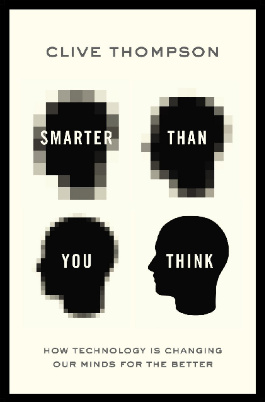
I'm Clive Thompson, the author of Smarter Than You Think: How Technology is Changing Our Minds for the Better (Penguin Press). You can order the book now at Amazon, Barnes and Noble, Powells, Indiebound, or through your local bookstore! I'm also a contributing writer for the New York Times Magazine and a columnist for Wired magazine. Email is here or ping me via the antiquated form of AOL IM (pomeranian99).